



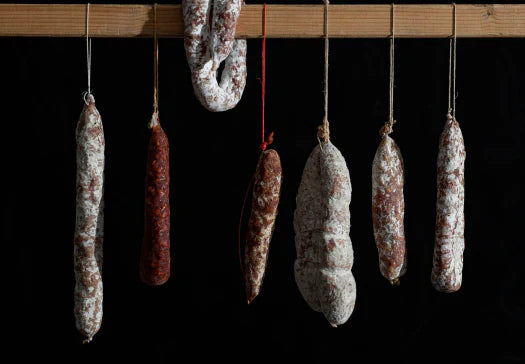
Saucisson is a very popular cured meat (beyond the Ardèche region) and undergoes many transformations in different parts of the world. It is a speciality that comes in a wide variety of forms and flavours, and this can sometimes make the choice difficult for consumers.
To help you, there is a simple rule that will allow you to recognise a good saucisson, which is called the rule of the 3 Fs.
It is based on three essential quality criteria: the "fleur" (bloom), the "forme" (shape), and the "ficelle" (string).
The Fleur (Bloom)

The "fleur" is the thin white (or grey-green) layer that forms on the surface of the saucisson and makes it so characteristic (it is also called "bloom" by our English-speaking friends). Our artisanal saucissons have a rather grey-green bloom, which indicates a gentle curing and slow drying characteristic of genuine artisanal production from the local region. Natural and wild, this particular bloom comes from the same microorganisms as the rind of delicious cheeses from the mountainous regions of southern France.
The texture and colour of the bloom are due to the presence of natural moulds that develop during the saucisson's ageing phase. It is a naturally occurring process.
The presence and quality of this bloom are important criteria for evaluating the quality of a saucisson. It indicates that the cured meat has been produced traditionally, and generally without chemical additives.
An abundant bloom is therefore a true guarantee of quality and respect for traditional ageing. But beware of industrial saucissons that use talc to fake the absence of natural bloom on their products. If you shake the saucisson and white powder falls off, it's industrial talc. Avoid it.
The Form (Shape)

The second F refers to the shape of the saucisson.
This is another important criterion that can help evaluate its quality.
Overall, a good saucisson should have a slightly irregular shape, as it takes its form within the pork casing with all the noble parts of the pig's dermis. It is therefore unique every time, incomparable every time.
If it looks like a perfectly straight "i", elongated amidst its clones, don't let it charm you; it means a machine made it. Instead, let yourself be seduced by our good local saucissons.
The Ficelle (String)

Finally, the string is a third important criterion for evaluating the quality of a saucisson.
The string used must be tight and regular, but not too tight so as not to crush the saucisson. If the string is poorly tied or too loose, it may indicate poor manufacturing quality.
Generally, a good saucisson is closed with strings on each side, not a metal staple, which may indicate that it is strictly industrially made. To verify this information, you can usually see a small plastic tuft easily identifiable in addition to the metal ring.
As quality casings are often more fragile, our saucissons are primarily held together by their meticulous lacing to keep them in the best possible condition.
The colour of the string can also give some clues about the quality of the saucisson. Natural strings, which are generally beige, are preferable to synthetic strings, which may contain certain chemicals.
In summary, the rule of the 3 Fs (fleur, forme, ficelle) is a relatively simple but quite effective criterion for quickly evaluating the quality of a good saucisson. It is important to prioritise saucissons that have an abundant bloom, a unique shape, and a string as a closure tie.
These few criteria indicate that the saucisson has been produced traditionally and has been carefully made with respect for craftsmanship. By following this rule, you can choose quality, tasty, and authentic saucissons, much like ours. Moreover, discover the quality and the traditional recipe of authentic Ardèche saucisson.
Otherwise, how do you assess the quality of a saucisson?
Overall, the rule of the 3 Fs is a good tool for evaluating the quality of a saucisson.
It can be used by both consumers to choose a good quality saucisson and by manufacturers to ensure that their products meet the highest standards and expectations for quality.
However, it is important to note that the rule of the 3 Fs should not be used as the sole indicator.
Other factors such as the ingredients used, the production process, and the maturation time will also have an impact on the quality of the saucisson and are not always visually measurable.
Moreover, the quality of saucisson can vary considerably depending on the manufacturer, the type of saucisson, and the region of production. It is therefore (highly) recommended to turn to artisanal producers (like us at La Boutique des Saucissons) to find superior quality products that will ensure the gastronomic quality of local products.
Our recipe is traditional and ardently upholds all the values of good Ardèche saucissons:
- quality pork meat (shoulder, belly, etc.);
- seasoning of the meat according to the traditional recipe (pepper, salt, garlic, red wine, and especially a lot of love…);
- stuffing with natural and premium pork casings, seeding of the bloom;
- curing of the saucissons;
- drying (between 5 to 7 weeks);
- unwrapped packaging (to avoid overpackaging).
Nothing more…
As artisanal producers, we use traditional production methods and superior quality ingredients to produce our saucissons, which we rightly consider (and our customers also) to be of high quality.


