



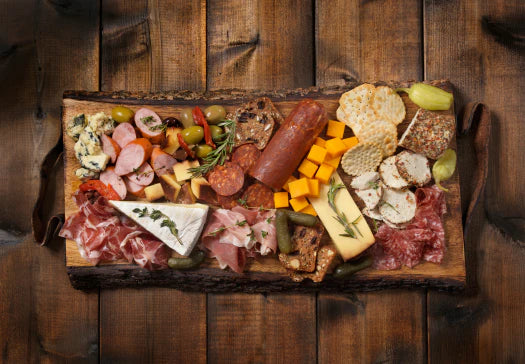
Choosing meats: focus on variety and quality
To create a beautiful charcuterie board, choose 5 or more varieties of cured meats. Start with cured ham, dry-cured saucisson, and a terrine or rillettes. Then add more original elements. Artisan charcuterie remains a safe bet. Here are some ideas:
Playing with the diversity of flavours
First, choose fairly classic charcuterie, with types of meat that everyone can enjoy: cured ham, pure pork saucisson, country terrine… Then elevate your platter with:
- Flavoured pieces like walnut, Bleu d'Auvergne, or Herbes de Provence saucisson, or a Cantal terrine;
- Spicy pieces like pimento fuet, pepper saucisson, or chorizo;
- Other types of meats, such as rabbit terrine or Corsican wild boar saucisson;
- Different tastes and textures, for example, by mixing the melting but powerful taste of a "gros bridé" (large saucisson), the drier heart of a curved sausage, and the full-bodied flavour of a figatellu.
Small tip: Corsican charcuterie is a real asset for your platter. The pieces benefit from smoking, which gives them a unique taste and aroma.
Composing a regional platter

Another idea for composing a beautiful charcuterie board is to offer a range of local specialities.
For an Ardèche platter, PGI saucisson is essential: "gros bridé," curved or straight sausage, the choice is yours. You can also opt for emblematic flavoured products like "gros bridé" with Saint-Joseph, walnut pâté, or Beaufort cheese saucisson.
For a charcuterie board with a Southern French taste, present Ardèche products and add a Herbes de Provence saucisson and an Aveyron "perche" (long, thin sausage).
For a more exotic platter, opt for Corsican charcuterie: figatellu, lonzu, and coppa accompanied by a Corsican dry sausage and a wild boar saucisson.
Playing with the diversity of shapes
Composing a beautiful charcuterie board also means playing with visual appeal. Focus on contrast by combining large and small slices. You can also cut sausages diagonally.
Alternate slices of "bridé," fuet, and walnut saucisson to achieve and admire the result. Add ham, "sarments" (thin, dry-cured saucissons), or "grignottes" (small, crunchy saucissons), and you'll have an irresistible platter.
Small tip: to avoid racking your brains, choose from our boxes. Each already contains several varieties of charcuterie that you can simply prepare and present to your guests, with no risk of a false note.
Choosing accompaniments to serve with your charcuterie board
A charcuterie board implies accompaniments. Even if saucissons and rillettes are perfectly sufficient on their own, they're even better with other flavours.
Toasted bread is essential if you're serving a terrine or pâté. For more flavour, you can choose sesame bread. Add salted biscuits (crackers) or crisps if your guests enjoy these appetisers.
Furthermore, a good assortment of fruits and vegetables will give your board a touch of originality and substance.
You can opt for bitter or acidic
In this case, gherkins and olives form a classic contrast to accompany the fat of the meat. You can also innovate by presenting grapefruit slices. And for even more spice, why not serve pimento-stuffed olives?
The sweetness of seasonal fruits for a sweet and savoury platter
In summer, melon is perfect with ham, while pineapple pairs very well with spicy saucissons. Don't hesitate to take advantage of the sweetness of peaches and apricots to enhance the full flavour of artisan saucisson. Other seasonal fruits like raspberries or blackberries will also be perfect to accompany your board.
Figs and apples adapt to almost anything, adding crunch to your platter. Grapes are also very versatile.
Dried fruits, a sure bet sometimes underestimated
Hazelnuts, cashews, pistachios, and almonds will bring an unprecedented richness to your platter. Snacking on a few dried fruit kernels between two bites of meat allows you to appreciate their full flavour.
Vegetables: a wide choice of colours and flavours
A simple green salad and cherry tomatoes can enhance your board if you don't have much time to prepare. Grated carrots and boiled asparagus, or even broccoli and peppers, will add colour to the platter.
For more refinement, consider parsleyed mushrooms, sun-dried tomatoes, chutney vegetables, or grilled courgette or aubergine.
Sauces, not to be forgotten
Mayonnaise remains the versatile sauce par excellence, but there are other interesting options like tartare sauce, mushroom pâté mixed with cream cheese, or even guacamole. You can also offer several sauces depending on the composition of your platter.
Cheeses, a must-have
Just like with charcuterie, the idea is to present varied cheeses, hard or soft, more or less strong… If you're short on ideas, stick to the essentials: mozzarella, camembert, and Roquefort.
If you're preparing a raclette, there's no need to add cheese to your charcuterie platter. In this case, you also don't need a wide variety of meats. Ham and saucissons can be quite sufficient, provided you choose quality products.
A careful presentation for an irresistible board
For two or three people as an aperitif, a single medium-sized platter will suffice. For example, you can choose a round slate platter for a chic bistro style. If you have several guests, two options are available:
- A large format platter, which can be adapted for an aperitif for up to about 6 people;
- Several smaller platters if you have more guests, to facilitate access.
To compose a beautiful charcuterie board, simply arrange the elements by playing with contrast: alternate slices of ham and saucisson rounds with fruit squares and vegetable sticks. Add the cheese slices, then fill the remaining space with dried fruits, and you're done.
For special occasions, allow yourself more fanciful presentations, for example, an assortment of charcuterie in the shape of a Christmas tree for Christmas.
You can place small ramekins of sauce on the boards (in the centre if it's a round platter) or next to them: this depends on the available space.
Practical questions: quantity calculation, charcuterie board preparation, and drinks
If you're serving a charcuterie board as an aperitif, about 80g of meat per person will suffice. If it's a cocktail dinner, plan for double.
For the preparation of your charcuterie plate, make sure to take out the ingredients early enough. They should be at room temperature for tasting. This applies especially to cheeses, which should not be too hard or too soft.
If you plan to serve your charcuterie board to seated guests, you can present relatively large pieces, accompanied by a knife. However, for a standing cocktail, remember to cut everything into bite-sized pieces in advance. This way, your guests will only have to pick from the platter with one hand and hold their drink with the other.
Speaking of drinks, a good glass of wine remains the best companion for a charcuterie board. But you can also opt for craft beer, classic and refreshing. A lager will be a crowd-pleaser, and if you know your guests well, you can present a more original variety, like a "gratte-cul" or a Session IPA.


