

Have you ever wondered what happens before a saucisson bite comes to sit behind the day's door? We are opening the doors of our Ardèche workshops. Because a good advent calendar does not begin in December: it begins weeks earlier, with patience, craft… and a good deal of love for the product.
Short answer: Our saucisson Advent calendar is made in our workshops in Joyeuse, in the southern Ardèche, to traditional recipes. It brings together 87 pieces for 818 g: 84 saucisson bites spread over 21 doors, that is 4 mini saucissons per door, plus 3 whole saucissons. All of them go through the same method: mincing and seasoning of the “mêlée”, filling into casings, a warm fermentation phase, then slow drying. Meat 100% of French origin, with no colouring and no drying accelerator.
Where is the saucisson Advent calendar made?
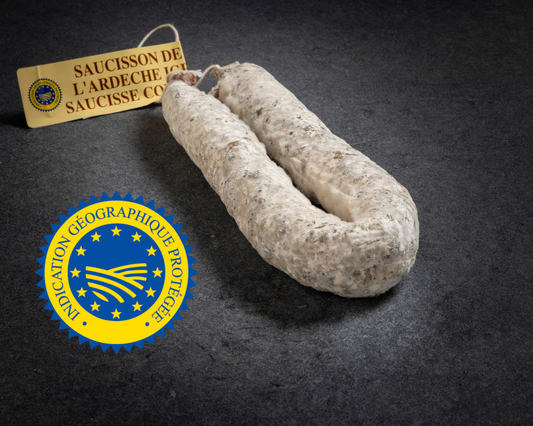
Our advent calendar is made in the southern Ardèche, in our workshops in Joyeuse, by the artisans of Charcuteries Debroas — the family business that has carried on our craft since 1952. We do not boast about the terroir: we work it. You will also find our full range of Ardèche saucissons, several of which carry the Ardèche PGI label.
What exactly do we make to fill the 24 doors? (spoiler alert)
Unlike most saucisson calendars, which offer one piece a day, ours contains 87 for a total weight of 818 g. So there are two distinct productions behind the box:
- 84 saucisson bites, in seven flavours — twelve of each: pure pork, Cantal, hazelnut, black olives from Nyons, tomato, Parmesan and truffle. They fill 21 doors, four per day. The same spirit as our mini saucissons and our flavoured saucissons.
- 3 whole saucissons — pure pork, with Cantal and with walnuts. On those days you are not opening a single mouthful, but enough to slice and treat the whole table.
We were the first to slip whole saucissons into the doors of an advent calendar. The idea came from a simple observation: a saucisson calendar is most often an individual affair, one mouthful a day, for yourself. With three whole pieces, the box becomes shareable — and three December evenings turn into real aperitifs. Enough to put together a handsome charcuterie board without warning anyone.
How are the saucisson bites made?
The calendar's saucisson bites are made using the same method as our classic saucissons, in four main stages:
- The mêlée: the pork and the fat are minced, then seasoned (salt, pepper, spices). This mixture is called the “mêlée”. The balance we aim for: around 80% lean to 20% fat.
- Filling into casings: the mêlée is filled into the casing, which gives the saucisson its shape.
- The warm fermentation phase: a short spell in the warm that starts fermentation and develops the aromas.
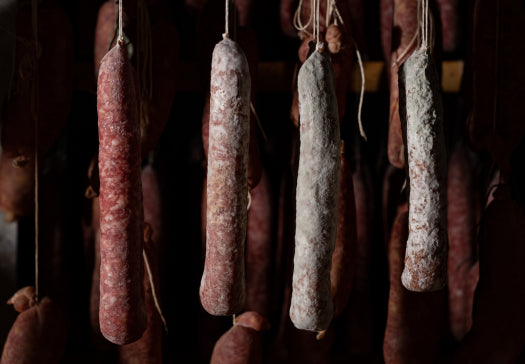
- The drying: several weeks in the drying room, at controlled temperature and humidity, until the texture is exactly right.
We do not rush our saucissons. We give them time. And it is that long, slow time that makes all the difference between an industrial product and a genuine artisanal saucisson — the same process as for traditional Ardèche saucisson.
And the three whole saucissons, how are they made?
Same method, but more labour and more time. Each whole saucisson is filled into a natural pork casing, then tied by hand, piece by piece — a gesture no machine really replaces. Then comes the warm fermentation phase, which starts fermentation, followed by the drying room, where the dry air of the Cévennes does the rest. Allow three weeks minimum.
No drying accelerator, no colouring. The meat is exclusively of French origin. That also explains the difference in format: a saucisson bite of a few grams dries quickly, a whole saucisson calls for patience — and that is precisely why it keeps for several weeks after its door is opened, whereas the saucisson bites are best eaten within the following days. Our advice on storing saucisson properly applies to the calendar's contents too.
What is the “bloom” on a saucisson?
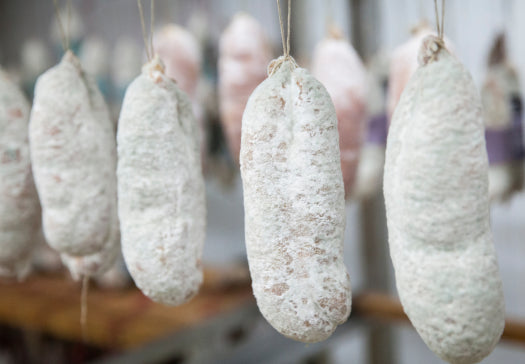
The “bloom” on a saucisson is that fine, natural grey-green film covering the surface of the saucisson after drying. Far from being a flaw, it is a mark of quality: it protects the saucisson, regulates its drying and shows that natural maturing has gone well. You will see it above all on the three whole saucissons in the calendar, and that is a good sign: they were made properly.
Did you know? The bloom on a saucisson is edible. It is up to you to keep it for a more rustic taste, or to peel the skin off gently if you prefer a softer texture. There is no wrong answer: it is purely a matter of taste.
Why choose a calendar made the artisanal way?
Choosing an advent calendar made the artisanal way means making sure the contents match the thought behind it. An artisanal saucisson means selected meat, controlled seasoning and patient drying — where industry is mainly trying to move fast. The result: more flavour, more character, and the pleasure of knowing exactly what you are eating. To go further, compare what is on the market with our comparison of the 2026 saucisson Advent calendars, or see which savoury advent calendar to choose according to the food lover in question.
Conclusion
Behind every little door there are weeks of work. That is the real recipe for our advent calendar: time, craft and a touch of pride. So when you open the day's door — four saucisson bites, or one of the three whole saucissons — you will know where it comes from… and why it is so good. Discover the 2026 edition of the calendar.
FAQ — your questions about how our calendar is made
Where are the saucissons in the advent calendar made?
They are made in the southern Ardèche, in our workshops in Joyeuse, since 1952. The meat is exclusively of French origin.
Does the calendar contain whole saucissons?
Yes. Of the 24 doors, 21 each contain four saucisson bites and the final 3 a whole saucisson: pure pork, with Cantal and with walnuts. That is 87 pieces in total, for 818 g.
Is the grey film on the saucisson normal?
Yes, entirely. It is the “bloom”, a natural film that comes from maturing. It is edible and a sign of successful drying.
How long does it take to make a saucisson?
After preparing the mêlée and filling the casings, drying takes a minimum of three weeks. It is that long, slow time that gives the saucisson its flavour and texture.
Do your saucissons contain additives?
We favour traditional production with simple ingredients, with no colouring and no drying accelerator. For the detailed composition of each item, please refer to the corresponding product label.