



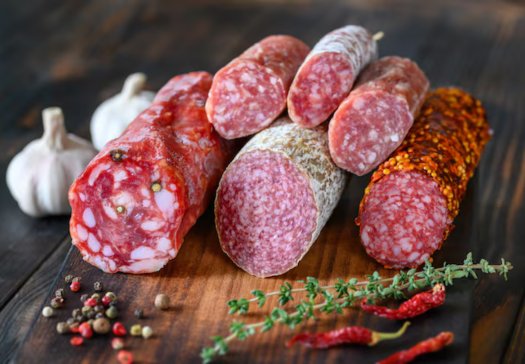
Artisanal dry-cured saucisson comes in many varieties and unique flavours, each offering a memorable taste experience. Here's an overview of the main types of dry-cured saucissons to add to your list for your next aperitifs.
Artisanal or industrial dry-cured saucisson?
Before delving into the different varieties, it's important to distinguish between two main categories of dry-cured saucissons:
- True artisanal saucisson is exclusively made from natural ingredients, including the casing and string. A bloom covers the saucisson, a sign of slow, natural air-drying. In Ardèche, the exceptional climate promotes this maturation and gives the saucisson's bloom a grey-green colour. Contrary to popular belief, the natural casing of artisanal saucisson is edible and adds to its unique taste.
- Industrial saucisson: wrapped in a smooth synthetic casing (edible or not), it often contains additives like flavour enhancers. While convenient, this type of saucisson is less healthy and less flavourful than its artisanal counterpart. For an authentic experience, always choose artisanal charcuterie, which is both delicious and healthier.
Types of dry-cured saucissons by size
Artisanal saucisson is made using natural pork casings, and the size varies depending on the casing used. This is how we differentiate between the different types of saucissons.
Classic dry-cured saucisson
Most dry-cured saucissons are stuffed into pork chitterlings, which have varying diameters. This is the saucisson we encounter most often (they are distinguished more by their place of manufacture).

Mini saucissons
They are generally stuffed into pork small intestine, a thinner casing which allows for slimmer pieces. The drying and ageing of mini saucissons therefore take less time compared to other types of saucissons. In our shop, you'll find a box of mini saucissons that gives you the opportunity to taste several flavours without worrying about waste. It also makes a great gift idea.
Sausage on a pole (saucisse à la perche)
It has roughly the same dimensions as regular saucisson, but is distinguished by its curved shape. This is because the sausage is wrapped around a pole. In our catalogue, we offer Aveyron pole sausage, a delicious regional saucisson that is sure to delight your guests, served whole with a good knife.

Le Jésus and La Rosette
The Rosette de Lyon and the Jésus have one thing in common: their impressive size. These two dry-cured saucissons are stuffed into the caecum, cecum, or pork sack, a part located at the anterior end of the large intestine, which has a larger diameter than the rest of the casings. Le Jésus is distinguished by its shape resembling a huge pear.
Types of saucissons by their composition
French dry-cured saucisson is mainly made from pork. Our master charcutiers use a basic mixture composed of 80% lean meat and 20% fat, with pieces from the noble parts of the animal (ham, shoulder). However, there are also other types of saucissons that contain other meats, as well as different flavours to vary the pleasures.
Flavoured dry-cured saucissons
If you're looking for an original experience, try flavoured saucissons: from a simple pepper coating to pieces of Cantal, through herbs de Provence and hazelnuts, there's something for everyone. Regional cheeses marry wonderfully with meat, each in their own way: the intensity of Roquefort, the buttery softness of young Cantal, or the slight acidity of goat cheese give each type of saucisson a different flavour, full of character. Dried fruits provide an irresistible crunch, while herbs and spices make the charcuterie even more refined. We also have an authentic flavoured flagship product that won the prize for best saucisson in 2023: the Saint-Joseph dry-cured saucisson, an AOC red wine from Ardèche.
Corsican saucissons: from Nustral pork to wild boar
Corsican charcuterie is traditionally made from Nustral pork, a breed raised semi-free for several months, then slaughtered at the beginning of winter. Today, this type of meat is no longer as available as it once was, but we have retained the traditional recipes and the concern for quality by using only "Porc français" labelled meat. This is what constitutes our lonzu, coppa, and figatellu. We also offer wild boar dry-cured saucisson, still following Corsican traditions.

Chorizo: a saucisson of Iberian origin
Originally, chorizo exists in two versions: dry-cured saucisson, more prevalent in Spain, and cooking sausage, found more in Portugal. In all cases, this charcuterie is distinguished by the use of pimento, a spice that gives it its spiciness and rust colour. At La Boutique des saucissons, we offer a 100% French chorizo, based on a French Catalan recipe.
Types of labelled dry-cured saucissons
Some saucissons have specific labels: PGI, PDO, Label rouge. Each of them indicates specific characteristics.
Label rouge
Label rouge certification is a "French mark of quality that attests that a product has a higher level of quality than a similar everyday product." This quality is based on the product's sensory qualities, production conditions, as well as its presentation and related service. It is a label awarded by the State and controlled by the National Institute of Origin and Quality (INAO).
PDO or AOC label
The Protected or Controlled Designation of Origin is a label that directly concerns the origin of the products. For example, the pork saucisson "Noir de Bigorre" is made from the meat and fat of pigs of this breed. Similarly, the saucisson of Charolles is exclusively made from Charolles meat. This also concerns the other ingredients that go into the composition of the saucisson, like our flavoured with Beaufort cheese. We use a PDO cheese which therefore meets the specifications for the production of this regional product.
PGI label
The Protected Geographical Indication is a label linked to the production location of the saucisson. Thus, our Ardèche PGI saucisson is an authentic piece made according to the artisanal know-how of the region, benefiting from the climatic conditions of the terroir. All stages of the production of this type of saucisson are carried out in Ardèche by passionate master charcutiers, following the ancestral recipe and traditional values.


